Why Transcription Tools Mangle Nigerian English
Why transcription tools built for American English mangle Nigerian English — and what a system built for how Nigerians speak does differently.
Try this experiment. Open any popular transcription app and record yourself speaking the way you normally speak in a Nigerian office. Not the careful, deliberate English you might use in a formal presentation, but the way you actually talk to your colleagues. Then look at what the tool produces.
If your experience is anything like ours, the output will range from mildly inaccurate to completely unusable. Words will be swapped, sentences will be mangled, and entire phrases will just disappear. The tool is not broken. It simply was not built for the way you speak.
Nigerian English Is Not "Accented" American English
This is the fundamental misunderstanding that most speech recognition systems operate under. They treat any English that does not sound like a General American accent as a deviation from the norm -- something to be corrected or compensated for.
But Nigerian English is not a distorted version of American English. It is its own fully developed variety of English with consistent pronunciation rules, grammatical structures, and vocabulary. Linguists have studied it extensively. It has predictable patterns. The problem is that ASR developers have not bothered to learn those patterns.
What Specifically Goes Wrong
Here are the concrete ways standard speech recognition breaks down with Nigerian English.
Pronunciation Differences
Nigerian English has distinct phonetic characteristics that confuse models trained on American speech. The "th" sound in words like "think" and "that" is often pronounced as "t" or "d" -- so "think" becomes "tink" and "that" becomes "dat." This is not random. It is a systematic pattern shared by most Nigerian English speakers. But an ASR system hears "tink" and has no idea what to do with it.
Vowel sounds are different too. Nigerian English tends to use purer vowel sounds compared to the diphthongs common in American English. The word "face" might sound closer to "fehs" than the American "fayss." The word "go" is pronounced with a single vowel rather than the American glide. These differences are small individually, but they compound across every word in a sentence.
Stress and Rhythm
American English is stress-timed, meaning some syllables are emphasized and others are reduced. Nigerian English tends to be syllable-timed, giving roughly equal weight to each syllable. This completely changes the rhythm of speech and throws off ASR systems that use stress patterns to identify word boundaries.
When a Nigerian speaker says "development," they give clear weight to every syllable: de-ve-lop-ment. An American speaker swallows some syllables: d'VEL'pm'nt. The ASR model expects the American version and gets confused by the Nigerian one.
Local Expressions and Meaning Shifts
This is where things get really interesting. Nigerian English has hundreds of expressions that use standard English words but with completely different meanings.
"I'm coming" does not mean the speaker is approaching. It means "wait" or "I will be right back." If a transcription is being used to create meeting minutes, the meaning difference matters enormously.
"Flash me" means "give me a missed call." "Off the light" means "turn off the light." "He is not on seat" means "he is not at his desk." "Let me land first" means "let me finish what I am doing."
Standard ASR tools transcribe the words correctly but have no mechanism to flag that the meaning might differ from what a non-Nigerian reader would expect. For purely internal Nigerian teams this might not matter. But for any document that crosses cultural boundaries, it becomes a source of confusion.
Code-Switching
In most Nigerian professional settings, speakers do not stick to one language. A single sentence might start in English, include a Yoruba phrase, and end with a Pidgin expression. This is natural and efficient communication, not linguistic confusion.
But standard ASR systems are monolingual by design. When you select "English" as your language, the model tries to interpret everything as English. That Yoruba phrase in the middle of your sentence will either be dropped entirely or transcribed as nonsense English words that happen to sound vaguely similar.
How Autrans Handles This Differently
We built Autrans with Nigerian English as a first-class target, not an afterthought. The system is built for and tested against Nigerian speakers from different regions and linguistic backgrounds, so the phonetic patterns above are treated as how the language sounds -- not as errors to repair.
Autrans knows Nigerian English expressions. It knows that "I'm coming" is a valid and complete utterance in context. It does not try to correct Nigerian English into American English because there is nothing to correct.
And when a speaker shifts between English, Pidgin, and major Nigerian languages within the same conversation, Autrans follows the speaker instead of forcing every word through an English-only lens -- code-switching is handled as the normal way Nigerians talk, because it is.
The result is transcription that actually sounds like the person who said it. Not a sanitized, Americanized version of what they said, but what they actually said, the way they actually said it. That is what accurate transcription means, and it is what Nigerian professionals deserve from their tools.
Related
Yoruba, Igbo and Hausa-Influenced English in Transcripts
Your first language shapes your English, and each one leaves its own transcript errors.
Tobiloba Sulaimon
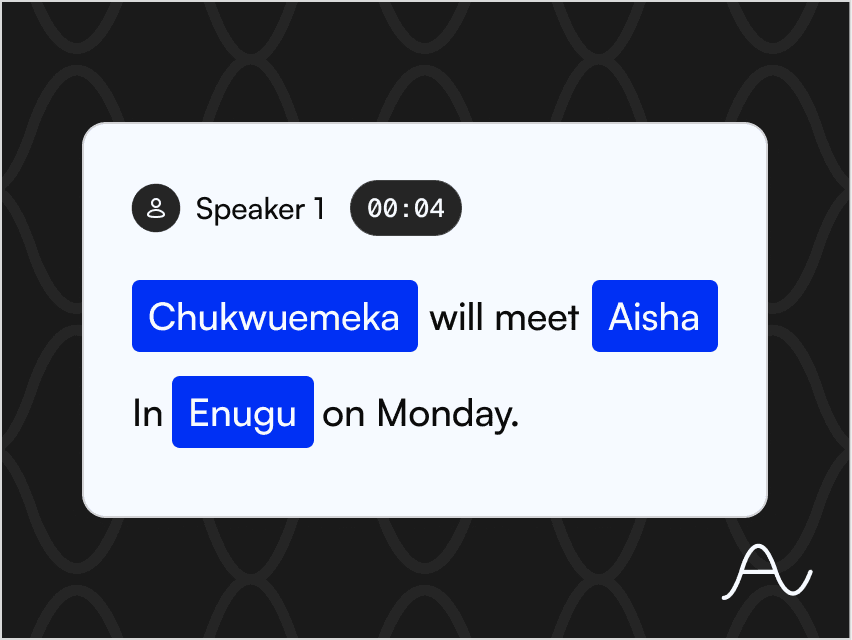
Nigerian Names and Places: The Proper-Noun Problem
Adeyemi, Chukwuemeka, Ikorodu: the errors that matter most, and how to fix them.
Tobiloba Sulaimon
Autrans vs Otter.ai for Nigerian English & Pidgin: An Honest Comparison
Where Otter genuinely wins, where it slips on Nigerian audio, and who should pick which.
Tobiloba Sulaimon
Start transcribing free
Get 30 minutes of free transcription to start. No credit card required. Just upload your audio and go.