Nigerian Pidgin Transcription: A Language, Not an Error
Nigerian Pidgin is a language, not broken English. Why standard AI corrects it away, and how Autrans transcribes Pidgin as spoken.
There is something deeply frustrating about speaking a sentence in Nigerian Pidgin into a transcription tool and watching it "correct" your words into standard English. You said "I no sabi" and the tool wrote "I know something." You said "wetin dey happen" and it returned "what is happening." The words are technically related, but the meaning, the tone, the intent -- all lost.
This is what happens when AI tools treat Nigerian Pidgin as broken English rather than what it actually is: a distinct language with its own rules, its own grammar, and somewhere between 75 and 100 million speakers.
Pidgin Is Not Broken English
Let us be very clear about this because the misconception runs deep, even among some Nigerians. Nigerian Pidgin (sometimes called Naija) is a creole language. It developed from contact between English and various West African languages, but it has evolved its own complete linguistic system.
Pidgin has consistent grammar rules. The sentence structure follows predictable patterns. Verb conjugation works differently from English but it works systematically. "I dey go" (I am going), "I go go" (I will go), "I don go" (I have gone) -- these are not random corruptions of English. They are a tense system that any linguist would recognize as internally coherent.
Pidgin has its own vocabulary that does not map one-to-one to English. "Wahala" means trouble or problem but carries connotations that the English words do not. "Shakara" describes a specific kind of showing off. "Japa" has become a culturally loaded term that goes far beyond its literal meaning.
Pidgin has pragmatic rules about when and how certain expressions are used. The way you use "abeg" (please) changes meaning depending on tone and context. It can be a sincere request, a dismissal, or an expression of exasperation.
Treating all of this as "English that needs to be fixed" is not just technically wrong. It is an erasure of a language that is central to Nigerian identity and daily life.
What Standard ASR Does to Pidgin
When you feed Pidgin speech into a standard English ASR system, the results are predictably bad, but they are bad in a specific and revealing way. The system does not just produce errors. It actively tries to normalize Pidgin into standard English.
Here is what happens with a typical sentence:
What was said: "If you no get money, nobody go look your face."
What standard ASR produces: "If you know, get money. Nobody go look your face."
The system heard "no" and transcribed it as "know" because in its English-trained world, "you no get" is not a valid construction but "you know" is. It then had to insert punctuation to make the resulting sentence somewhat grammatical. The meaning was completely changed.
Another example:
What was said: "Make we dey go before rain catch us."
What standard ASR produces: "Make we they go before rain catch us."
The system does not know what to do with "dey" so it substitutes the closest-sounding English word, "they," which makes no sense in context.
These are not edge cases. This is what happens consistently, across every Pidgin sentence, when you use tools that were not built for the language. The output is not just inaccurate -- it is misleading. Someone reading the transcript who was not present for the original conversation would come away with a completely different understanding of what was said.
Why This Matters Beyond Convenience
Nigerian Pidgin is the most widely spoken language in Nigeria. More people speak Pidgin daily than speak standard English. It is the lingua franca in markets, in offices, in newsrooms, in churches, and increasingly in media and entertainment.
Nollywood films use Pidgin extensively. Nigerian music is largely in Pidgin. Wazobia FM broadcasts entirely in Pidgin. The BBC has a Pidgin language service. This is not a marginal language -- it is arguably the dominant everyday language of Africa's most populous country.
When transcription technology cannot handle Pidgin, it means that a huge portion of Nigeria's spoken communication simply cannot be converted to text accurately. Media houses cannot efficiently transcribe Pidgin broadcasts. Researchers cannot analyze Pidgin discourse at scale. Organizations cannot create accessible text versions of Pidgin audio content.
There is also a documentation concern. Pidgin is an evolving language, and the way it is spoken today is different from how it was spoken twenty years ago. Accurate transcription creates a textual record that linguists and cultural historians can study. Bad transcription that normalizes Pidgin into English destroys that record.
How Autrans Transcribes Pidgin
Building a Pidgin transcription product required us to reject the assumption standard tools are built on: that anything which is not standard English is an error to be repaired.
First, we treat Pidgin as a language in its own right, not a dialect of English to be normalized. Autrans transcribes Pidgin as one of the two languages the system is tuned hardest for, together with Nigerian English -- a language you can rely on, not an accent setting bolted onto an English tool.
Second, we test relentlessly against real Nigerian speech -- radio-style broadcasts, market conversations, interviews, and everyday workplace audio, with all the background noise and overlap that comes with them. A system that only handles careful, textbook Pidgin read into a good microphone would fail the audio Nigerians actually record, so that is not the bar we measure against.
Third, and this is crucial, Autrans preserves Pidgin as spoken. If the speaker said "I no sabi," the transcript reads "I no sabi." The system does not second-guess the speaker. It does not assume they meant to say something in standard English and made a mistake. It respects the language.
We also handle the reality that Pidgin exists on a continuum. Some speakers use a form of Pidgin that is very close to English. Others use a heavier, more basilectal form. And most real recordings switch between Pidgin, English and other Nigerian languages mid-sentence -- which is exactly the case Autrans is built to follow.
The Bigger Picture
Getting Pidgin transcription right is not just a technical achievement. It is a statement about what we value. When we build AI tools that only work for dominant global languages, we are implicitly saying that other languages do not matter. When we build tools that actively "correct" those languages into English, we are saying something even worse.
Autrans takes the opposite position. Pidgin is a language. It deserves to be transcribed accurately, not corrected. And the millions of people who speak it deserve tools that work for them, not against them.
Related
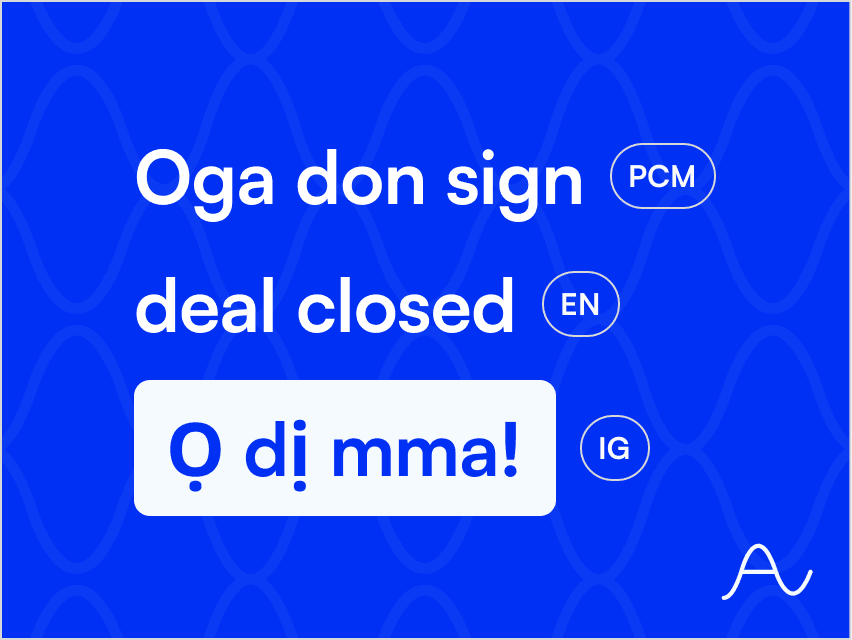
Code-Switching: When One Sentence Holds Three Languages
One sentence, three languages: why that is normal speech, and what it does to transcripts.
Tobiloba Sulaimon
Yoruba, Igbo and Hausa-Influenced English in Transcripts
Your first language shapes your English, and each one leaves its own transcript errors.
Tobiloba Sulaimon
How to Transcribe Swahili Audio
Dialects across East Africa, borrowed words, and what makes Swahili recordings usable.
Tobiloba Sulaimon
Start transcribing free
Get 30 minutes of free transcription to start. No credit card required. Just upload your audio and go.