How to Transcribe Igbo Audio: A Practical Guide
A practical guide to transcribing Igbo audio: why generic tools fail on Igbo, what to realistically expect today, and how to get the best results.
Igbo is one of Nigeria's three major languages, spoken by more than 30 million people across the southeast and the diaspora. It carries centuries of history, proverbs, and culture. And yet, if you have ever tried to convert Igbo audio into text using mainstream tools, you already know the truth: most of them barely try.
We want to give you a practical, honest guide to transcribing Igbo audio in 2026 -- what is genuinely hard about it, what Autrans does well today, where we still fall short, and how to get the cleanest possible transcript from the recordings you already have.
We are going to be straight with you throughout. Igbo is not yet our strongest language. We think telling you that, plainly, is more useful than a marketing promise you would discover was false the first time you uploaded a file.
Why Igbo Is Genuinely Hard to Transcribe
Before we talk about tips and tools, it helps to understand why Igbo resists automatic transcription in ways that English simply does not. This is not an excuse. It is the terrain.
Igbo is tonal. The same sequence of letters can mean completely different things depending on pitch. The classic textbook example is akwa, which can mean cloth, egg, cry, or bed depending on tone. A human listener uses context and pitch together to resolve this instantly. A machine has to learn both the sound and the melody underneath it, and tone is far harder to model than consonants and vowels. Errors in tone are a major source of errors in meaning.
Igbo has many dialects. Owerri, Onitsha, Nsukka, Aro, and dozens of local varieties differ in vocabulary, pronunciation, and even grammar. Central Igbo (sometimes called Standard Igbo) is the form used in media, education, and most published writing -- but a recording from a village meeting or an elder telling a story may sit well outside that standard. The wider the gap from Central Igbo, the harder the job.
Igbo data is scarce. This is the quiet, structural problem behind the other two. AI transcription learns from enormous quantities of recorded speech paired with accurate text. For English, that data exists in oceans. For Igbo, it is a puddle by comparison. Decades of digital neglect mean there is simply far less material to learn from, which limits how good any system -- ours included -- can be today.
Set your expectations honestly. For clear, mostly Central Igbo speech with good audio, Autrans produces a usable draft that is far faster to correct than typing from scratch. For heavy dialect, overlapping voices, noisy field recordings, or rapid tonal speech, expect to do real editing. Igbo transcription today is a strong head start, not a hands-off finish.
What Autrans Does With Igbo Today
We built Autrans for African and Nigerian speech specifically, rather than bolting Nigerian languages onto a tool designed for American English. That focus matters for Igbo even though the language is still developing in our system.
In practice, here is what works well right now:
- Clear, Central Igbo speech. A presenter, a teacher, or a pastor speaking deliberately into a decent microphone gives you the best results. This is the sweet spot.
- Igbo-English code-switching. Real Igbo speech, especially in cities and churches, constantly slides between Igbo and English within a single sentence. Autrans is built to handle that mixing rather than choking on it or trying to force everything into one language.
- Speaker separation. For interviews and conversations, Autrans can label who spoke when, so a two-person interview reads like a transcript rather than a wall of text.
- Standard exports. You get your transcript as text, subtitles, and other common formats, ready to edit or publish.
And here is where we still fall short, stated plainly: heavy non-Central dialects, fast overlapping speech, poor-quality audio, and fine tonal distinctions are where errors cluster. We are actively investing in Igbo and the transcripts keep getting better, but English and Nigerian Pidgin currently give you stronger out-of-the-box results.
If that honesty seems unusual, it is deliberate. We would rather you trust us on the easy files and know exactly when to expect editing on the hard ones.
Igbo Transcription on Autrans
See current capabilities, supported dialects, and frequently asked questions about transcribing Igbo audio.
Practical Tips for Better Igbo Transcripts
The single biggest lever you control is not the software -- it is the audio you feed it. These steps consistently move results from frustrating to genuinely useful.
1. Prioritise clear audio above everything. Record close to the speaker, away from generators, fans, traffic, and crowd noise. A clean phone recording of one person beats an expensive recording of a noisy room. If you can choose where to sit during an interview, choose the quiet corner.
2. Lean toward Central Igbo where you can. You cannot change how an elder speaks, and you should not try to. But if the recording is something you control -- a narration, a lesson, a planned segment -- speaking closer to Standard Igbo will sharply improve accuracy. For archival recordings of regional dialects, just plan for more editing time.
3. Let code-switching happen naturally. Do not coach speakers to avoid English. Autrans expects the Igbo-English blend that real conversation uses, and forcing artificial "pure" speech often sounds stilted without helping accuracy.
4. Avoid heavy overlap. When two people talk over each other, even human transcribers struggle. Encourage one voice at a time, especially in panels and group discussions.
5. Treat the first pass as a draft. Read the transcript against the audio and correct it. Because tone and dialect cause specific, predictable slips, your corrections get faster as you learn where the system tends to stumble.
Doing a sensitive cultural or oral-history recording? Capture a short, clearly spoken introduction at the start -- names, place, date, in Central Igbo if possible. It gives both the system and any future human editor a clean reference point before the harder material begins.
Where Igbo Transcription Actually Helps
Even with today's limits, accurate-enough Igbo transcripts unlock work that was previously slow or impossible.
Sermons and church services. Igbo and Igbo-English services are a huge part of life in the southeast and the diaspora. Transcribing them lets churches publish teachings, build searchable archives, and reach members who prefer to read.
Interviews and research. Journalists, students, and researchers recording Igbo speakers can get a draft transcript in minutes instead of hours, then refine it -- a transformative time saving even when editing is needed.
Nollywood and cultural media. Subtitling Igbo-language film and online video widens its audience enormously. A solid draft transcript is the starting point for subtitles that travel beyond Igbo speakers.
Cultural and oral-history archives. This is where we feel the responsibility most. Proverbs, songs, and the voices of elders deserve to be preserved in text. Imperfect transcription that you then correct is still vastly better than recordings that sit undocumented because transcribing them by hand was never going to happen.
Try Igbo transcription on your own audio
Upload a clear Igbo or Igbo-English recording and see the draft for yourself. Honest results, fast turnaround, Naira pricing.
Start Transcribing FreeHow to Transcribe Igbo in Autrans, Step by Step
The workflow is the same as any other language on the platform:
- Sign in and upload your file. Common audio and video formats work. For best results, upload the cleanest version of the recording you have.
- Select Igbo as the language. This tells Autrans to use its Igbo handling, including the Igbo-English code-switching support.
- Turn on speaker labels if you have multiple voices. This is worth it for interviews, panels, and conversations.
- Let it process, then review. You will get a draft transcript with timestamps. Play the audio alongside it and correct as you go.
- Export what you need. Plain text for documents, subtitle files for video, and other standard formats are all available.
That is it. The discipline is in steps 1 and 4 -- give it clean audio, and treat the output as a draft you finish, not a final product you trust blindly.
What Is Code-Switching?
Understand why mixing Igbo and English mid-sentence is normal speech, not an error, and how it affects transcription.
Sermon Transcription
See how churches use Autrans to turn Igbo and Igbo-English services into searchable, shareable text.
The Honest Bottom Line
Igbo deserves far better digital tools than it has historically received, and closing that gap is exactly why we exist. We are not going to tell you Igbo transcription is solved, because it is not -- not by us, not by anyone. The tone, the dialects, and the years of scarce data make it genuinely hard.
What we will tell you is this: for clear Igbo speech, Autrans already saves you real time and gives you a transcript worth correcting rather than starting from zero. For harder recordings, it gets you a head start that did not exist before. And every month, with more Igbo speech flowing through the system, it gets better.
We would rather earn your trust by being honest about the hard parts than lose it by overpromising. Upload a file, judge it for yourself, and hold us to the standard Igbo deserves.
Related
How to Transcribe Hausa Audio: A Practical Guide
Sermons, interviews and broadcasts in Hausa, and how to get clean transcripts of them.
Tobiloba Sulaimon
How to Transcribe Yoruba Audio: A Practical Guide
Why tone trips up generic tools on Yoruba, and how to get cleaner transcripts anyway.
Tobiloba Sulaimon
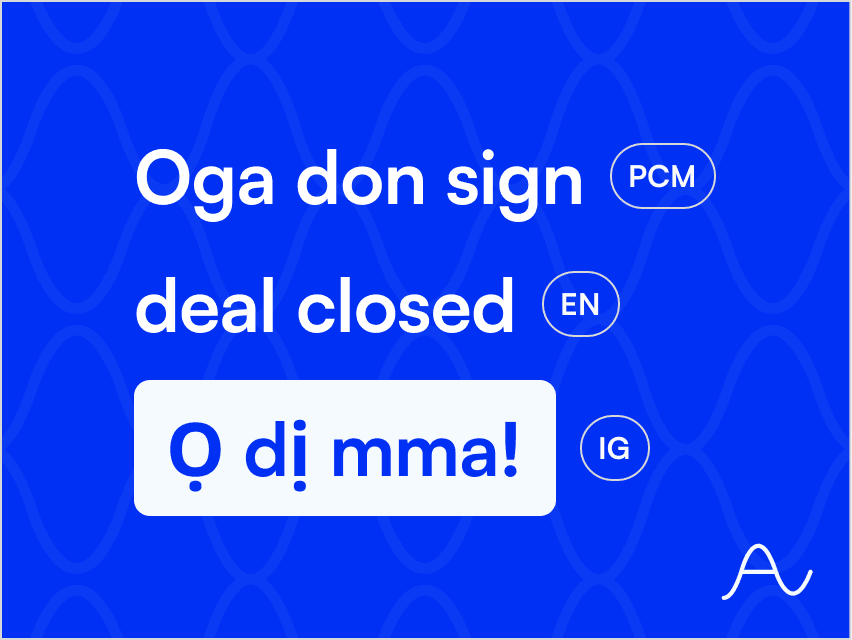
Code-Switching: When One Sentence Holds Three Languages
One sentence, three languages: why that is normal speech, and what it does to transcripts.
Tobiloba Sulaimon
Start transcribing free
Get 30 minutes of free transcription to start. No credit card required. Just upload your audio and go.