Why African Language Transcription Matters More Than You Think
Transcription technology ignores most African languages. Why that gap matters for journalism, research and archives — and what closing it takes.
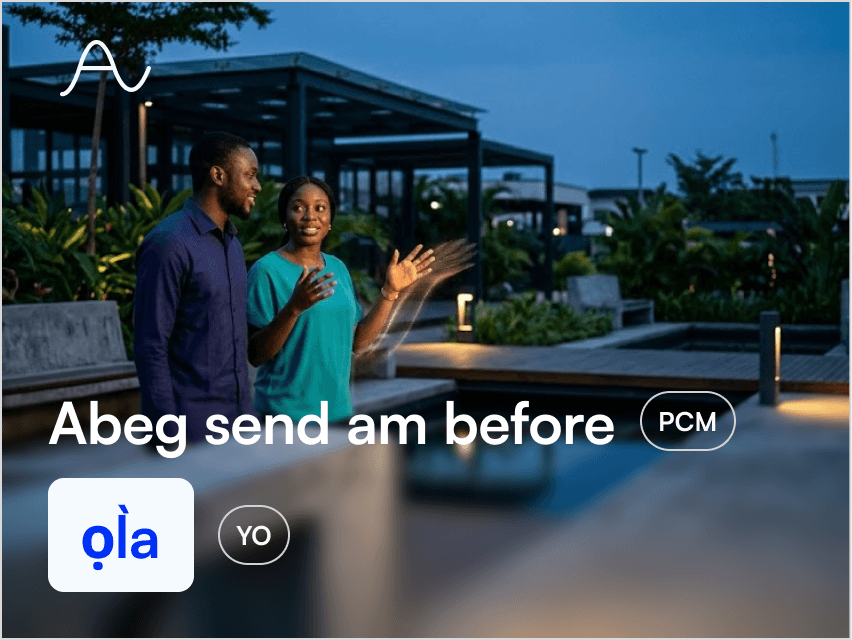
Africa is home to more than 2,000 languages. Nigeria alone has over 500. Yet if you open any major transcription tool right now and speak Yoruba into it, you will get gibberish. Speak Hausa, and it might try to interpret it as Arabic. Speak Igbo, and it will just give up entirely.
This is not a minor inconvenience. It is a systemic failure in how AI technology has been built, and it has real consequences for millions of people across the continent.
The Problem With How AI Transcription Was Built
Most automatic speech recognition (ASR) systems were trained primarily on American English. Some have expanded to include British English, Mandarin, Spanish, French, and a handful of other globally dominant languages. But African languages have been almost entirely left out of the training data.
The reason is straightforward but frustrating: training data. Building a good ASR model requires thousands of hours of transcribed audio in a given language. For English, that data exists in abundance. For Yoruba or Igbo or Twi, it barely exists at all. The major tech companies have not invested in collecting it because they do not see the market as profitable enough.
The result is that an entire continent of over 1.4 billion people is underserved by one of the most fundamental AI applications in existence.
Who Actually Suffers From This
The impact is not abstract. Real professionals deal with this gap every single day.
Journalists and media professionals in Nigeria regularly conduct interviews in Pidgin, Yoruba, or Hausa. They then have to manually transcribe hours of audio because no tool can do it for them. A journalist in Lagos told us she spends roughly 40% of her working time on manual transcription. That is time she could spend reporting.
Researchers and academics studying African societies, languages, and cultures need accurate transcriptions of interviews and oral histories. When they use standard tools, they get unusable output and end up hiring human transcribers at significant cost.
Legal professionals need accurate records of proceedings and depositions. When those proceedings happen in local languages or Nigerian English, standard transcription tools produce documents full of errors that require extensive manual correction.
Business teams across Nigeria hold meetings where participants switch between English, Pidgin, and local languages within the same sentence. No mainstream tool can handle this code-switching, so meeting notes either get done manually or not at all.
The Scale of What Is Being Lost
There is a deeper issue here beyond productivity. When AI tools cannot process African languages, it creates a subtle but powerful pressure to abandon those languages in professional settings. If you know the transcription tool only works in standard English, you start conducting your meetings in standard English even when it would be more natural and effective to speak in your own language.
Over time, this contributes to language shift. Professional domains become English-only spaces, and local languages get pushed further into informal contexts. The technology that was supposed to make work easier ends up making cultural preservation harder.
This also means that a massive amount of spoken knowledge in African languages is simply not being captured. Oral histories, community meetings, religious sermons, traditional ceremonies, radio broadcasts -- all of this audio content exists but cannot be efficiently converted to searchable, shareable text.
Why We Built Autrans
Autrans exists because we believe transcription technology should work for African languages, not just the languages that Silicon Valley happens to speak.
We started by focusing on the languages and dialects most commonly used in Nigerian professional settings: Nigerian English, Nigerian Pidgin, Yoruba, Hausa, and Igbo. Our approach is different from the big tech companies in a few important ways.
First, we hold ourselves to real-world African audio. Not studio recordings of people reading scripts, but actual meetings, interviews, and conversations with background noise, overlapping speakers, and natural code-switching -- that is the audio we build for and measure ourselves against, because it is the audio that actually exists.
Second, we treat the specific patterns of African languages as the target rather than trying to force them into a frame designed for American English. Tonal languages like Yoruba carry meaning in pitch, Pidgin has its own grammar, and Nigerian English has its own phonetics -- Autrans is built around that reality from the ground up, not adapted to it as an afterthought.
Third, we treat code-switching as a feature, not a bug. When a speaker moves from English to Yoruba mid-sentence, Autrans does not break. It follows along.
This Is Just the Beginning
We are starting with Nigeria because it is what we know best, but the long-term vision is much broader. The technical approaches we are developing for Nigerian languages can be adapted for other African languages. And the need is just as urgent in Kenya, Ghana, South Africa, and everywhere else on the continent.
African language transcription is not a niche problem. It affects hundreds of millions of people. The gap exists not because the problem is unsolvable, but because nobody with the resources to solve it has considered it a priority. We think that needs to change, and we are building Autrans to prove it can.
Related
How to Convert an MP3 to Text
Check the file, set the language honestly, then read the first pass with the audio open.
Tobiloba Sulaimon
How to Transcribe an Audio File in Nigeria, Step by Step
Six steps from a recording on your phone to a transcript you can actually use.
Tobiloba Sulaimon
How to Transcribe an MP4 Video to Text
Skip extracting the audio: upload the video as it is, and get text and subtitles back.
Tobiloba Sulaimon
Start transcribing free
Get 30 minutes of free transcription to start. No credit card required. Just upload your audio and go.